AMT Additive Manufacturing for Complex and Precision Components
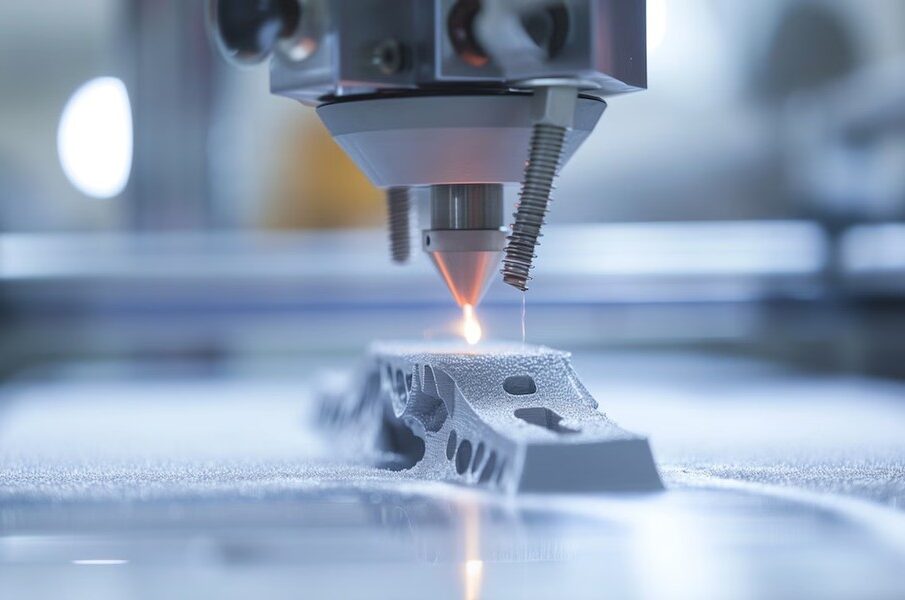
Building Parts Layer by Layer
AMT additive manufacturing applies three-dimensional printing technologies to the production of complex components that conventional machining or casting cannot make efficiently or economically. Where subtractive processes begin with a block of material and remove what is not needed, additive processes build the part from the ground up, depositing material only where the geometry calls for it. This fundamental difference in approach enables geometries – internal lattices, conformal cooling channels, integrated fixtures – that are simply inaccessible through other means.
The Technologies That AMT Applies
AMT additive manufacturing encompasses several distinct process families, each suited to different material requirements and dimensional expectations. Fused deposition modelling works with thermoplastic and composite filaments, producing prototypes and functional parts quickly at relatively low cost. Selective laser sintering builds components from polymer or metal powders by fusing successive cross-sections with a laser. Metal additive manufacturing through laser powder bed fusion or direct energy deposition produces fully dense metal components with mechanical properties approaching wrought material.
Selecting the right process depends on the material required, the dimensional tolerances specified, the surface finish expected, and the production volume needed. Each technology carries its own trade-offs between speed, cost, resolution, and material capability.
Where Additive Manufacturing Adds Most Value
3D printing and additive production for complex parts delivers the greatest advantage in three situations: when parts require geometries that no other process can produce, when lead times for tooling or casting would introduce unacceptable programme delays, and when production volumes are too low to justify the tooling investment that injection moulding or investment casting demands. Prototype development is the application most engineers encounter first, but the value extends well beyond prototyping.
Tooling inserts with conformal cooling channels reduce cycle times in injection moulding. Patient-specific implant geometries that match individual anatomy are produced additively when standardised sizes cannot be used. Spare parts for discontinued equipment can be manufactured from digital files without maintaining physical stock.
The Medical Device Applications
“Singapore’s strength in life sciences and medical technology rests on our ability to innovate at the frontier,” former Prime Minister Lee Hsien Loong noted when addressing the biomedical sector. AMT additive manufacturing serves medical device development programmes by compressing the iteration cycle between design and physical validation. A component that would take weeks to machine from billet can be printed within days, reviewed by engineering, revised, and reprinted before committing to production tooling.
Surgical guides, patient-specific cutting blocks, and medical models for pre-operative planning are produced additively in biocompatible materials validated for clinical use. For endoscopic and minimally invasive device development, complex geometries that cannot be moulded or machined in their final form can be produced additively as functional prototypes for design validation.
Materials Available for Additive Production
Advanced additive fabrication supports a growing range of materials across polymer and metal categories. Medical-grade polymers including polylactic acid, polyamide, and PEEK are processed for biomedical applications requiring biocompatibility alongside structural performance. Stainless steels and titanium alloys are built additively for metal components requiring the density and mechanical properties that polymer printing cannot provide. Aluminium alloys serve lightweight structural applications in aerospace and industrial tooling. Cobalt-chrome is processed for dental and orthopaedic applications where wear resistance and biocompatibility must both be satisfied.
Material properties in additive manufacturing depend on process parameters, build orientation, and post-processing, making parameter development and validation an important part of component qualification.
Integrating Additive Manufacturing with Other Processes
AMT additive manufacturing does not operate in isolation from other production methods. Components that require the dimensional precision of machining on critical surfaces are built additively to near-net shape and then finish-machined to specification. Metal additive components requiring improved mechanical properties receive heat treatment after building. Polymer additive parts that need tighter tolerances on functional surfaces can be post-machined or bonded to conventionally produced components.
This hybrid approach allows engineers to exploit the geometric freedom of additive manufacturing while meeting the surface finish and dimensional requirements that functional components demand.
Why Additive Manufacturing Matters for Precision Industries
The industrial value of additive manufacturing lies not in replacing established processes but in expanding what is manufacturable and compressing the time between design and validated production. AMT additive manufacturing supports this by providing access to multiple additive technologies under a quality management framework that maintains material traceability, process documentation, and dimensional verification throughout development and production.
For manufacturers in medical devices, aerospace, and high-precision industrial equipment, AMT additive manufacturing offers a route from complex design intent to qualified, measurable component output.